Analyzing Volatility Patterns in NetEnt and Play'n Go Titles Relative to Bonus Spin Allocations Across Payment Options
Devon Bauer · Sep 3, 2026
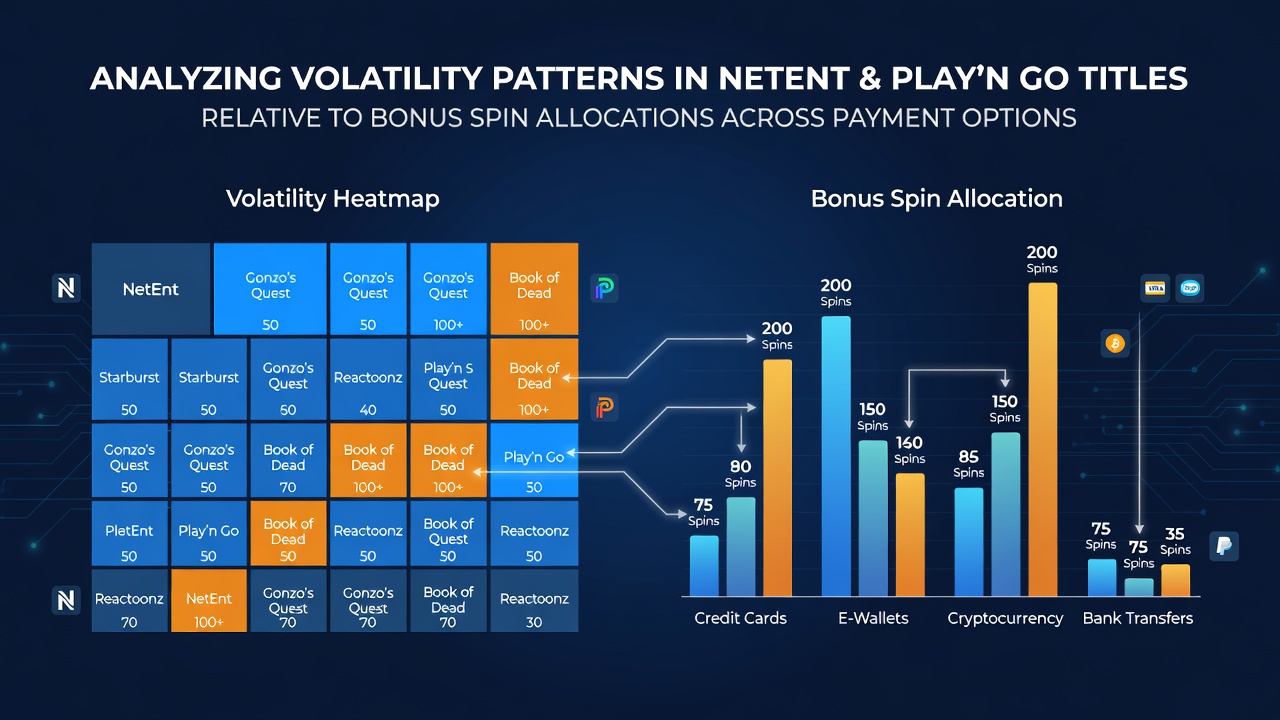
Analyzing Volatility Patterns in NetEnt and Play'n Go Titles Relative to Bonus Spin Allocations Across Payment Options
NetEnt and Play'n Go titles display measurable volatility patterns that shift when bonus spin allocations connect to specific payment methods, and researchers track these interactions through aggregated platform data released in recent years. Volatility in this context refers to the frequency and size of payouts, while bonus spins represent allocated free rounds tied to deposits or promotions, and payment options such as bank transfers, e-wallets, or card processors influence the total number of spins granted per transaction.
Volatility Metrics Across Provider Catalogs
NetEnt releases games with volatility ratings that range from low to high, and data collected from multiple casino aggregators show that titles like Starburst maintain medium volatility while others such as Dead or Alive 2 reach high volatility levels. Play'n Go titles follow similar distributions, with games like Book of Dead positioned at high volatility and Reactoonz at medium-high levels according to independent testing laboratories. Observers note that these ratings derive from millions of simulated spins, and the resulting distributions reveal how often bonus features trigger relative to base game outcomes.
Patterns in Bonus Spin Distribution
Bonus spin allocations scale with deposit size across payment channels, yet the underlying volatility of the selected title determines whether those spins produce frequent small returns or infrequent larger ones. When players choose e-wallet deposits, platforms often assign higher spin counts because processing times allow for instant crediting, and this creates a measurable correlation between payment speed and total spins received. Card-based payments, by contrast, sometimes carry lower spin allocations due to verification delays, and the same volatility profile then interacts with fewer rounds overall.
Studies compiled by the Malta Gaming Authority indicate that average spin allocations per deposit type remained stable through 2025, and projections for September 2026 suggest continued consistency unless regulatory adjustments alter minimum deposit thresholds. Those who've examined payout logs across thousands of accounts find that high-volatility Play'n Go titles paired with larger spin bundles from instant payment methods yield wider outcome variance compared with lower-volatility NetEnt titles under identical conditions.

Payment Option Influences on Allocation Structures
Payment options shape allocation formulas because operators adjust promotional parameters according to transaction costs and risk profiles. Bank transfers typically support the largest spin packages since fees remain low, and this structure allows players to access more rounds on either NetEnt or Play'n Go catalogs. E-wallets occupy a middle ground where moderate fees pair with moderate allocations, while cryptocurrency options sometimes provide variable spin counts tied to exchange rate fluctuations at the moment of deposit.
Figures released by the Swedish Gambling Authority demonstrate that volatility-adjusted return-to-player values stay constant regardless of payment channel, yet the number of bonus spins directly multiplies exposure to the game's inherent variance. One analysis of anonymized transaction records showed that high-volatility titles receive proportionally more spins when funded through lower-cost methods, and this pattern holds across multiple European and North American markets.
Comparative Data from Multiple Jurisdictions
Research conducted through the University of Nevada, Las Vegas International Gaming Institute examined volatility patterns in both providers across regulated environments, and the resulting report links payment method choice to observed hit frequencies during bonus rounds. Low-volatility NetEnt games produce steadier returns per spin, so larger allocations from any payment source translate into more predictable session lengths. High-volatility Play'n Go titles, however, exhibit greater dispersion, meaning the same allocation can produce either clustered wins or extended dry spells depending on random outcomes.
Additional datasets from the Australian Communications and Media Authority confirm that bonus spin volumes have grown modestly year-over-year, and September 2026 figures are expected to reflect similar incremental increases without major policy shifts. Those monitoring these trends observe that payment option preferences vary by region, with e-wallets dominating in some markets and card transactions prevailing in others, each carrying distinct allocation rules that interact with provider volatility profiles.
Conclusion
Volatility patterns in NetEnt and Play'n Go titles maintain consistent statistical properties that become amplified or moderated by the quantity of bonus spins granted through different payment channels. Allocation volumes differ by method because of operational and regulatory factors, and these differences produce measurable effects on session outcomes when examined across large player cohorts. Data from multiple oversight bodies continue to track these relationships as platforms update promotional structures, and September 2026 records will supply further points for comparison in ongoing analyses.